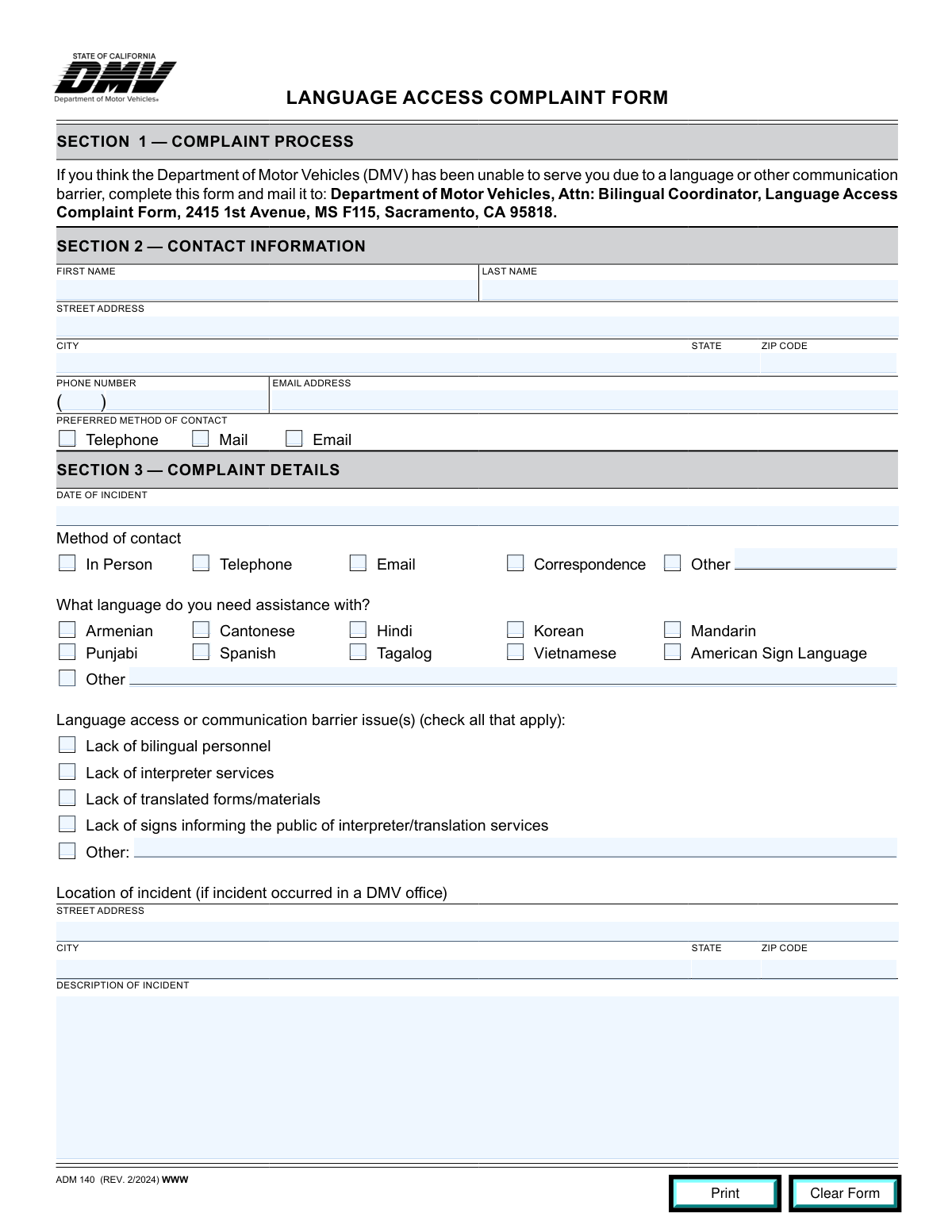
Yes! You can use AI to fill out Form ADM 140, Language Access Complaint

Form ADM 140, Language Access Complaint, is used to report issues related to language barriers experienced at the DMV. It helps ensure that individuals with limited English proficiency can access DMV services effectively.
Our AI automatically handles information lookup, data retrieval, formatting, and form filling.
It takes less than a minute to fill out Form ADM 140 using our AI form filling.
Securely upload your data. Information is encrypted in transit and deleted immediately after the form is filled out.

Form specifications

Form name: Form ADM 140, Language Access Complaint
Number of fields: 44
Number of pages: 2
Official download URL: https://www.dmv.ca.gov/portal/uploads/2024/08/ADM-140-R2-2024-ASB-WWW-8.6.2024.pdf
Language: English
main-image

Instafill Demo: filling out a legal form in seconds

How to Fill Out Form ADM 140 Online for Free in 2025

Are you looking to fill out a FORM ADM 140 form online quickly and accurately? Instafill.ai offers the #1 AI-powered PDF filling software of 2025, allowing you to complete your FORM ADM 140 form in just 37 seconds or less.
Follow these steps to fill out your FORM ADM 140 form online using Instafill.ai:
  1. 1 Visit instafill.ai site and select Form ADM 140.
  2. 2 Enter your first and last name.
  3. 3 Provide your contact information and preferred method.
  4. 4 Describe the incident and language assistance needed.
  5. 5 Sign and date the form electronically.
  6. 6 Check for accuracy and submit the form.

Our AI-powered system ensures each field is filled out correctly, reducing errors and saving you time.

Why Choose Instafill.ai for Your Fillable Form ADM 140 Form?

Speed

Complete your Form ADM 140 in as little as 37 seconds.

Up-to-Date

Always use the latest 2025 Form ADM 140 form version.

Cost-effective

No need to hire expensive lawyers.

Accuracy

Our AI performs 10 compliance checks to ensure your form is error-free.

Security

Your personal information is protected with bank-level encryption.

Frequently Asked Questions About Form Form ADM 140

The Language Access Complaint Form is designed to allow individuals to report issues related to language access services. It provides a structured way for individuals to express their concerns and seek resolution regarding the availability and quality of language assistance provided by organizations.

The Language Access Complaint Form should be used by individuals who have experienced difficulties in accessing language assistance services. This includes individuals who may have faced challenges in communication due to language barriers when interacting with service providers.

Once you have completed the Language Access Complaint Form, it should be submitted to the designated office or department responsible for handling language access complaints. The specific submission address or email will typically be provided in the instructions accompanying the form.

In the complaint details section, you will need to provide specific information regarding your experience, including the nature of the complaint, the date and time of the incident, the service provider involved, and any other relevant details that can help in the investigation of your complaint.

Through the Language Access Complaint Form, you can request various types of language assistance, including interpretation services, translation of documents, and any other support that facilitates effective communication in your preferred language.

If your language access complaint is not adequately addressed by the DMV, you may consider escalating the issue by contacting a higher authority within the DMV or seeking assistance from advocacy groups that specialize in language access issues. Additionally, you can file a formal complaint with the appropriate oversight agency.

After you submit your complaint to the DMV, it will be reviewed by the appropriate department. You may receive a confirmation of receipt, and the DMV will investigate the matter. Depending on the findings, they may take corrective actions or provide you with a response regarding the outcome of your complaint.

Yes, you can submit the Language Access Complaint Form anonymously. However, please note that providing your contact information may help the DMV to follow up with you for further clarification or to inform you about the resolution of your complaint.

The DMV has strict privacy policies in place to protect the information you provide on the Language Access Complaint Form. Your personal information will be kept confidential and will only be used for the purpose of addressing your complaint. It will not be shared with unauthorized parties.

You can contact the DMV for questions about the Language Access Complaint Form by calling their customer service hotline or visiting their official website for additional contact information. They may also have specific email addresses or office locations for inquiries related to language access.

The Dymally-Alatorre Bilingual Services Act is a California law that requires state agencies to provide bilingual services to individuals who are limited English proficient. This act aims to ensure that all individuals have access to government services in their preferred language, thereby promoting effective communication and equal access.

You can report various types of communication barriers using the Language Access Complaint Form, including difficulties in understanding or being understood due to language differences, lack of access to interpreters or translated materials, and any other challenges that hinder effective communication with limited English proficient individuals.

Yes, there is typically a deadline for submitting the Language Access Complaint Form. It is advisable to submit your complaint as soon as possible after the incident occurs to ensure timely resolution. Specific deadlines may vary, so it is recommended to check with the relevant agency for precise information.

If you need assistance in a language that is not listed on the Language Access Complaint Form, you should still submit your complaint. The agency is required to provide assistance and may arrange for interpretation services to accommodate your language needs.

The DMV ensures effective communication for limited English proficient individuals by providing bilingual services, including interpreters and translated materials. They also train staff to be aware of language access issues and to assist individuals in overcoming communication barriers.

In the description of the incident section, you should provide a detailed account of the incident you are reporting. This includes the date, time, and location of the incident, the individuals involved, and a clear explanation of what occurred. Be as specific as possible to help the reviewing authority understand the context and nature of your complaint.

Yes, you can request a follow-up after submitting your complaint. It is advisable to indicate your preference for follow-up communication in your complaint submission, including how you would like to be contacted, whether by phone or email.

If you do not have a phone number or email address to provide, you can indicate this on the form. It is still important to provide your mailing address so that the reviewing authority can contact you via traditional mail if necessary.

No, there are no consequences for not providing optional information on the form. While providing additional information may assist in the processing of your complaint, it is not mandatory, and your complaint will still be accepted without it.

To request corrections or deletions of your personal information held by the DMV, you should submit a written request to the DMV's privacy officer or designated department. Include your identifying information and specify the corrections or deletions you are requesting. The DMV will review your request in accordance with applicable laws and regulations.

Individuals who need language assistance outside of DMV services can access various resources, including community organizations that offer translation and interpretation services, local government agencies that provide language support, and non-profit organizations focused on assisting non-English speakers. Additionally, many libraries and educational institutions offer language classes and resources that can help individuals improve their language skills.

Compliance Form ADM 140
Validation Checks by Instafill.ai

1
Verifies that the form is sent to the correct address
This validation check ensures that the form is directed to the appropriate address, specifically the Department of Motor Vehicles, Attn: Bilingual Coordinator, Language Access Complaint Form, 2415 1st Avenue, MS F115, Sacramento, CA 95818. It confirms that the address is formatted correctly and includes all necessary components such as the street name, city, state, and zip code. By validating the address, it helps prevent delays in processing the complaint. This check is crucial for ensuring that the complaint reaches the right department without any issues.
2
Ensures that the first name is provided and is not left blank
This validation check verifies that the first name field is filled out and not left empty. It confirms that the user has provided their first name, which is essential for identifying the individual submitting the complaint. By ensuring this field is completed, it helps maintain the integrity of the complaint process. This check is vital for personalizing communication and ensuring that the complaint can be properly addressed.
3
Confirms that the last name is provided and is not left blank
This validation check ensures that the last name field is completed and not left blank. It verifies that the user has entered their last name, which is necessary for proper identification in the complaint process. By confirming this information, it helps to maintain a clear record of the complaint and facilitates effective communication. This check is important for ensuring that the complaint is associated with the correct individual.
4
Validates that the street address is complete and accurately entered
This validation check verifies that the street address provided is complete and accurately entered. It ensures that all necessary components of the address, such as the street number and name, are included and correctly formatted. By validating the street address, it helps to prevent any potential issues with mail delivery or processing of the complaint. This check is essential for ensuring that the complaint can be properly linked to the correct location.
5
Checks that the city of residence is specified and is not left blank
This validation check ensures that the city of residence is specified and not left empty. It verifies that the user has provided their city, which is a critical component of the address. By confirming this information, it helps to ensure that the complaint is processed in the correct jurisdiction. This check is important for maintaining accurate records and facilitating effective communication regarding the complaint.
6
Ensures that the state is selected from the dropdown list and is valid.
This validation check ensures that the user has selected a state from the provided dropdown list. It verifies that the selected state is one of the valid options available, preventing any invalid entries. By confirming the selection, it helps maintain the integrity of the data collected. This check is crucial for ensuring that the complaint is directed to the appropriate state authority.
7
Verifies that the ZIP code is entered correctly and follows the standard format.
This validation check verifies that the ZIP code entered by the user adheres to the standard format, which typically includes five digits. It ensures that the ZIP code is not only numeric but also correctly structured, preventing any potential errors in processing the complaint. By confirming the validity of the ZIP code, it helps in accurate routing and response to the complaint. This check is essential for maintaining the accuracy of location-based services.
8
Confirms that a valid phone number is provided, including the area code.
This validation check confirms that the phone number provided by the user is valid and includes the necessary area code. It ensures that the phone number follows the standard format, which typically consists of ten digits. By verifying the phone number, it helps facilitate effective communication between the complainant and the relevant authorities. This check is vital for ensuring that the complaint can be addressed promptly and efficiently.
9
Ensures that a valid email address is entered and follows the standard email format.
This validation check ensures that the email address entered by the user is valid and conforms to the standard email format. It verifies that the email contains the necessary components, such as an '@' symbol and a domain name, preventing any invalid submissions. By confirming the validity of the email address, it facilitates effective electronic communication regarding the complaint. This check is important for ensuring that the complainant receives timely updates and responses.
10
Checks that the preferred method of contact is selected (Telephone, Mail, or Email).
This validation check ensures that the user has selected a preferred method of contact from the available options: Telephone, Mail, or Email. It verifies that one of these methods has been chosen, preventing any ambiguity in how the user wishes to be contacted. By confirming the selection, it helps streamline communication and ensures that the complainant is reached through their preferred channel. This check is essential for enhancing user satisfaction and engagement.
11
Validates that the date of the incident is specified and is in the correct format.
This validation check ensures that the date of the incident is not only provided but also adheres to the required format. It verifies that the date is entered in a recognizable and standard format, preventing any ambiguity. By confirming the correct date format, it helps maintain the integrity of the data collected. This is crucial for accurate record-keeping and for any potential follow-up actions.
12
Ensures that the method of contact with the DMV is indicated (In Person, Telephone, Email, Correspondence, or Other).
This check confirms that the user has specified how they contacted the DMV, which is essential for understanding the context of the complaint. It verifies that one of the acceptable methods of contact is selected, ensuring that the complaint is processed through the appropriate channels. By validating this information, it helps streamline communication and follow-up processes. This also aids in identifying trends in how individuals prefer to communicate with the DMV.
13
Confirms that the language assistance needed is selected from the provided options.
This validation ensures that the individual has indicated the specific language assistance they require from the available options. It verifies that the selection is made from a predefined list, which helps in accurately addressing the needs of the complainant. By confirming this selection, it enhances the DMV's ability to provide appropriate support and resources. This is vital for ensuring effective communication and service delivery.
14
Verifies that all applicable language access or communication barrier issues are checked.
This check ensures that the user has identified all relevant language access or communication barrier issues that apply to their situation. It verifies that the appropriate boxes are checked, which helps in understanding the full scope of the complaint. By confirming this information, it aids in the DMV's efforts to address and resolve these barriers effectively. This is crucial for improving overall accessibility and service quality.
15
Ensures that the location of the incident is provided if it occurred at a DMV office, including street address, city, state, and ZIP code.
This validation check confirms that if the incident took place at a DMV office, the user has provided a complete and accurate location. It verifies that all necessary components of the address, including street address, city, state, and ZIP code, are included. By ensuring this information is captured, it facilitates proper investigation and follow-up regarding the complaint. This is essential for accountability and for improving service at specific locations.
16
Checks that a detailed description of the incident is provided, explaining the issues faced.
This validation check ensures that the user has provided a comprehensive account of the incident in question. It verifies that the description includes specific details about the issues faced, which is crucial for understanding the context of the complaint. The check confirms that the narrative is clear and sufficiently detailed to allow for an accurate assessment of the situation. By requiring this level of detail, the validation process helps to facilitate a more effective resolution to the complaint.

Common Mistakes in Completing Form ADM 140

Incomplete personal details in Section 2

Providing incomplete personal details can lead to delays in processing your complaint. It is essential to ensure that all required fields in Section 2 are filled out accurately, including your name, address, and contact information. Double-checking this section before submission can help prevent any issues. To avoid this mistake, take your time to review each field and ensure that no information is missing.

Missing or incorrect ZIP Code entry

An incorrect or missing ZIP Code can hinder the ability to process your complaint effectively. This information is crucial for identifying your location and ensuring that your complaint reaches the appropriate department. To avoid this mistake, verify your ZIP Code against official postal resources before entering it on the form. Additionally, consider using an address verification tool to ensure accuracy.

Failure to specify the Date of Incident

Not specifying the Date of Incident can lead to confusion and may result in your complaint being overlooked. This date is vital for the investigation process, as it helps establish a timeline of events. To prevent this mistake, make sure to clearly indicate the date in the designated field and double-check for accuracy. If the incident occurred over multiple days, provide the range of dates to give a complete picture.

Not selecting a Method of Contact

Failing to select a Method of Contact can result in a lack of communication regarding your complaint. It is important to indicate how you prefer to be contacted, whether by phone, email, or mail, to ensure that you receive updates and responses. To avoid this mistake, take a moment to consider your preferred method and mark it clearly on the form. Additionally, ensure that the contact information you provide is accurate and up-to-date.

Omitting the Description of Incident

Omitting the Description of Incident can significantly weaken your complaint, as it provides the necessary context for your concerns. A detailed description helps the reviewing body understand the situation and take appropriate action. To avoid this mistake, take the time to write a clear and concise account of the incident, including relevant details such as what happened, where it occurred, and any individuals involved. Reviewing your description for clarity and completeness before submission can also be beneficial.

Incorrectly filling out the Language Assistance Needed

Providing inaccurate information regarding the type of language assistance required can lead to delays in processing your complaint. It is essential to carefully assess your needs and select the appropriate options that reflect your situation. To avoid this mistake, take the time to review the available language assistance options and ensure that you select all that apply. Double-check your selections before submitting the form to ensure they accurately represent your needs.

Not checking all applicable Language Access issues

Failing to identify and check all relevant Language Access issues can result in an incomplete complaint that does not address all your concerns. It is crucial to thoroughly read through the list of issues and mark every applicable item. To prevent this oversight, consider making a checklist of the issues you wish to report and cross-reference it with the options provided on the form. This will help ensure that your complaint is comprehensive and accurately reflects your experiences.

Providing an invalid or incomplete Email Address

Submitting an invalid or incomplete email address can hinder communication regarding your complaint and may lead to missed updates or requests for additional information. Always verify that your email address is correct and complete, including the domain and any necessary punctuation. To avoid this mistake, consider sending a test email to yourself to confirm that the address is functional before entering it on the form. Additionally, ensure that you check for any typos or errors that could prevent successful communication.

Failing to review the form before submission

Neglecting to review the completed form can result in errors or omissions that could affect the outcome of your complaint. It is advisable to take a moment to read through the entire form after filling it out to catch any mistakes or missing information. To mitigate this risk, consider having a trusted individual review the form as well, as a fresh set of eyes may catch errors you might have overlooked. This final review step is crucial for ensuring that your complaint is submitted accurately and effectively.

Not using the correct mailing address for submission

Using an incorrect mailing address can lead to delays or non-receipt of your complaint, which can be frustrating and counterproductive. Always verify the correct mailing address provided in the instructions before sending your form. To avoid this mistake, consider writing down the address separately and double-checking it against the form's instructions. Additionally, if possible, use a reliable mailing method that provides tracking to ensure your complaint reaches the intended recipient.

Selecting an incorrect Preferred Method of Contact

Choosing the wrong preferred method of contact can lead to delays in communication and resolution of your complaint. It is essential to carefully consider how you would like to be reached, whether by phone, email, or another method. To avoid this mistake, review the options provided and select the one that best suits your needs. Double-check that the contact method you choose is one you regularly monitor.

Neglecting to provide a complete Street Address

Omitting parts of your street address can hinder the processing of your complaint and may result in a lack of follow-up. Ensure that you include all necessary components, such as the street number, street name, apartment or unit number, and city. To prevent this error, take a moment to verify your address against official documents or utility bills. Providing a complete address ensures that your complaint is directed to the correct location.

Using an outdated or incorrect phone number format

Submitting a phone number in an incorrect format can lead to communication issues and missed opportunities for follow-up. It is crucial to use the standard format for your region, including the area code and any necessary prefixes. To avoid this mistake, check the format guidelines provided on the form and ensure your number is current and accurate. Regularly updating your contact information can also help prevent this issue.

Not indicating the Location of Incident accurately

Failing to accurately indicate the location of the incident can result in confusion and delays in addressing your complaint. It is important to provide specific details, such as the name of the facility or the exact address where the incident occurred. To avoid this mistake, take the time to gather all relevant information before filling out the form. Clear and precise location details will facilitate a more efficient investigation of your complaint.

Failing to include First and Last Name

Omitting your first and last name can lead to your complaint being unprocessed or misattributed. Providing your full name is essential for identification and follow-up purposes. To prevent this mistake, ensure that you fill in your name clearly and legibly, as it appears on your identification. Including your full name helps establish your identity and ensures that you receive appropriate responses to your complaint.

Not understanding the Privacy Notice implications

Failing to comprehend the implications of the Privacy Notice can lead to unintended consequences regarding the confidentiality of your complaint. It is essential to read and understand how your information will be used and shared before submitting the form. To avoid this mistake, take the time to review the Privacy Notice thoroughly and consider seeking clarification if any part is unclear. Ensuring you are fully informed will help protect your rights and maintain the confidentiality of your complaint.
Saved over 80 hours a year

“I was never sure if my IRS forms like W-9 were filled correctly. Now, I can complete the forms accurately without any external help.”

Kevin Martin Green

Your data stays secure with advanced protection from Instafill and our subprocessors

Robust compliance program

Transparent business model

You’re not the product. You always know where your data is and what it is processed for.

ISO 27001, HIPAA, and GDPR

Our subprocesses adhere to multiple compliance standards, including but not limited to ISO 27001, HIPAA, and GDPR.

Security & privacy by design

We consider security and privacy from the initial design phase of any new service or functionality. It’s not an afterthought, it’s built-in, including support for two-factor authentication (2FA) to further protect your account.

Fill out Form ADM 140 with Instafill.ai

Worried about filling PDFs wrong? Instafill securely fills adm-140-r2 forms, ensuring each field is accurate.